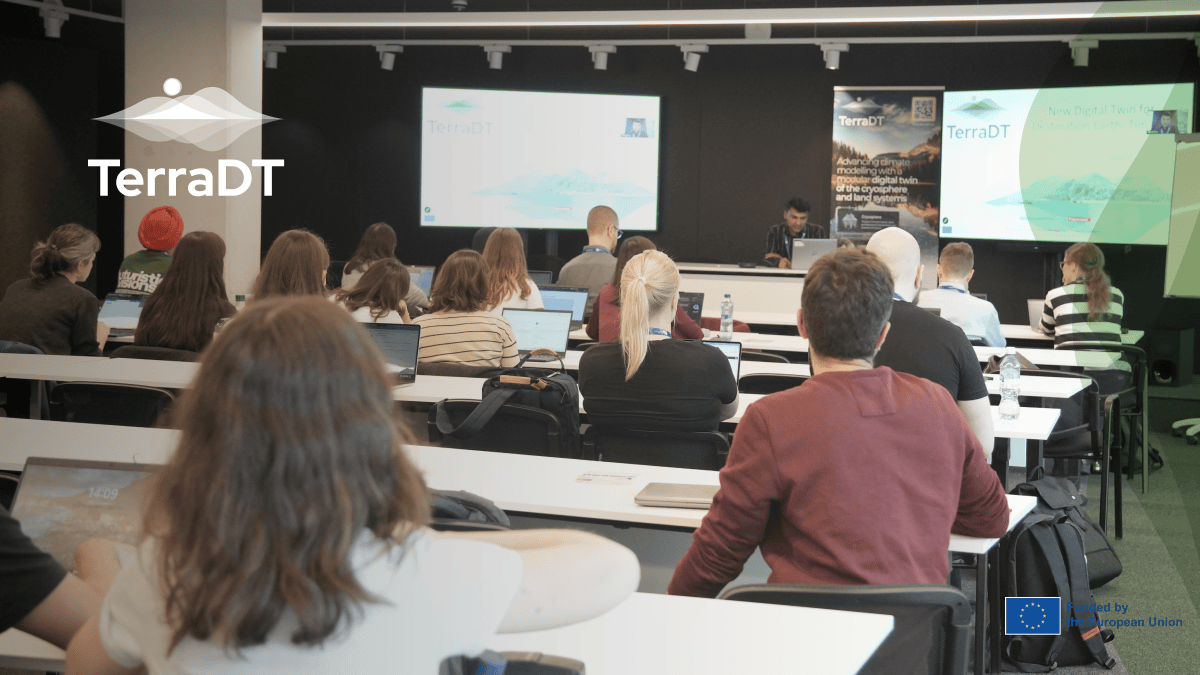
Over the past weeks, TerraDT has been present across key events in the digital twin and high-performance computing landscape, each reinforcing the project's commitment to advancing climate and environmental digital twins through collaboration, integration, and community feedback. Here's a look at what happened.
DestinE User eXchange: aligning with the wider ecosystem
TerraDT was represented at the DestinE User eXchange by partners at CSC: Jenni Kontkanen (project coordinator) and Tero Aalto strategic engagement and sustainability lead. This year's edition focused on the policy-maker community, a segment increasingly relevant to TerraDT's own mission.
Reflecting on the event, Aalto noted:
Being aligned with other initiatives and the development of the digital twin domain in general is essential for a project like TerraDT that aims at integration with the global ecosystem," says Tero Aalto, TerraDT's strategic engagement and sustainability lead, who represented the project at the event, "The User eXchange is one of the best opportunities to be in touch with the various user communities of Destination Earth. This year's edition focused on the policy-maker segment, which is highly relevant for us as well.
The event underscored a recurring priority for TerraDT: staying connected to the broader Destination Earth ecosystem and its diverse user communities, from technical developers to policymakers, to ensure the project's tools remain aligned with real-world needs.
HPCSE26: deep learning & aerosol science
At HPCSE26, TerraDT presented ongoing work on a machine-learning emulator designed to predict aerosol hygroscopicity parameters directly from atmospheric composition fields.
Aerosol hygroscopicity plays a critical role in shaping clouds, radiation, and air quality, yet physics-based simulations of these processes remain computationally expensive, limiting their use at the resolution and speed required by modern climate models. The emulator presented at HPCSE26 represents a step toward addressing this bottleneck: an AI-based aerosol process component built for eventual integration into high-resolution global climate models within the Destination Earth (DestinE) Climate Digital Twin initiative.
This work highlights a core theme for TerraDT: using machine learning not to replace physical understanding, but to make physics-based insight computationally tractable at scale.
Forest DTC User Meeting: listening to the community
The Forest Digital Twin Component (Forest DTC), developed as part of the ESA Digital Twin Earth Programme, organised an online user meeting to present recent advances in the system and demonstrate selected project use cases. Participants had the opportunity to learn about its current capabilities and share feedback on future development needs.
The meeting covered topics including:
• Forest growth modelling
• Forest management actions
• Disturbance dynamics.
The discussion provided valuable insights into user expectations and potential future applications of the Forest DTC. Participants highlighted the value of exploring different forest management scenarios through simulation, as well as the importance of effective visualisation and reporting capabilities.
The project team was pleased to receive feedback from users and stakeholders, and the insights gathered will help guide the continued development of the Forest DTC.
Looking Ahead
These events reflect only a few of the different dimensions of TerraDT's work: technical innovation in AI-driven climate modelling, close collaboration with domain-specific user communities, and strategic engagement across the wider digital twin ecosystem. As the project continues, we will continue to build on these connections to ensure our work leaves a positive mark on the resilience of our communities and in effective strategies for climate change adaptation.